Daily Budget vs Monthly Budget: Why Tracking Both Changes Everything

Here’s how most people budget:
- Set a monthly spending target
- Try to remember it throughout the month
- Check their bank balance occasionally
- Discover on day 28 that they’ve overspent
- Feel guilty, promise to do better next month
Sound familiar?
The problem isn’t willpower. The problem is feedback timing. A monthly budget gives you feedback once a month — which is exactly 30 days too late to do anything about it.
There’s a better approach: track a daily budget alongside your monthly one. Here’s why it works, and how to do it.
The Feedback Problem
Think about driving. Your speedometer doesn’t tell you your average speed at the end of the trip. It tells you your speed right now, constantly, so you can adjust in real-time.
Monthly budgets are like a speedometer that only works at the destination. By the time you see the number, the trip is over.
| Monthly Budget | Daily Budget |
|---|---|
| Feedback: once per month | Feedback: every purchase |
| ”You overspent by $200" | "You have $15 left today” |
| Discover problems on day 30 | Catch problems on day 3 |
| Requires memory and math | One glance, one number |
| Easy to ignore | Hard to rationalize away |
The daily budget is your financial speedometer. Every purchase updates it. Every glance tells you exactly where you stand.
How the Daily Budget Works
The math is simple:
Daily Budget = (Monthly Income − Fixed Expenses − Savings) ÷ Days in Month
Let’s break that down:
| Component | What It Includes | Example |
|---|---|---|
| Monthly Income | Take-home pay after taxes | $4,000 |
| Fixed Expenses | Rent, utilities, insurance, subscriptions | $2,000 |
| Savings Goal | What you want to save each month | $400 |
| Discretionary | What’s left for daily spending | $1,600 |
| Daily Budget | Discretionary ÷ 30 days | $53/day |
That $53 is your daily number. Stay under it, and you’ll have money left at month’s end. Go over it, and tomorrow’s budget adjusts to compensate.
Calculate Your Daily Budget
Your take-home pay
Everything that's the same each month
What you want to set aside
Enter your numbers above - results update automatically
The Psychology of Small Numbers
Here’s something interesting: $53 feels very different from $1,600.
When you have a $1,600 monthly budget, a $50 dinner seems small — less than 4% of your total. Easy to justify.
When you have a $53 daily budget, that same $50 dinner is nearly your entire day’s spending. Suddenly it requires thought.
The Same Expense, Different Framing
This isn’t a trick. It’s accurate framing. That $50 dinner does consume nearly a full day’s discretionary budget. The monthly view hides this; the daily view reveals it.
The result: you make more conscious choices. Not because you’re depriving yourself, but because you see the actual trade-offs.
The Color System: Instant Visual Feedback
Numbers are good. Colors are faster.
The daily budget becomes even more powerful when combined with visual feedback. BUDGT uses a color system that tells you where you stand in a fraction of a second:
| Color | Meaning | What to Do |
|---|---|---|
| Blue | Plenty remaining | Spend freely (within reason) |
| Yellow | Getting lower | Be mindful of purchases |
| Orange | Close to limit | Think carefully before spending |
| Red | Over budget | Stop — you’ll affect tomorrow |
| Grey | Fully spent | No more today without consequences |
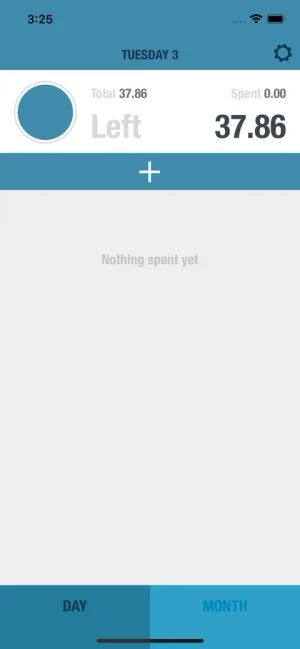
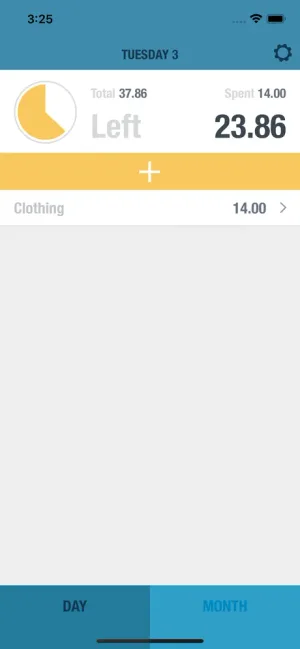
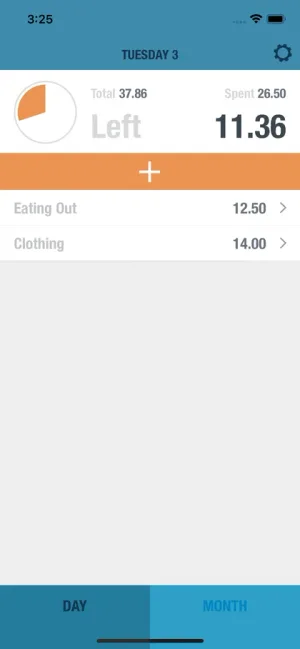
This bypasses the need for mental math. You don’t calculate “I’ve spent $38 out of $53, which means I have $15 left, which is 28% of my daily budget, which is…” You just see yellow. Be careful.
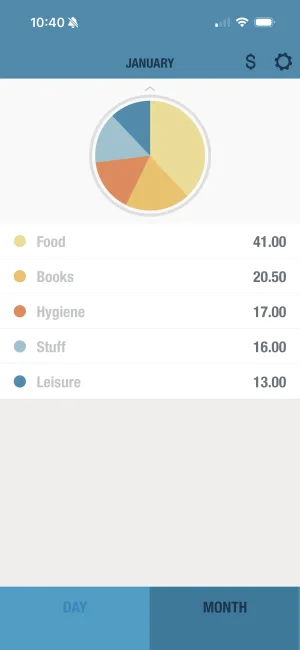
Daily and Monthly: Better Together
This isn’t about abandoning monthly budgets. It’s about using both:
Daily budget: Your real-time feedback mechanism. Tells you what you can spend right now. Keeps you on track day by day.
Monthly budget: Your progress report. Shows total spending, category breakdown, and month-end projection. Helps you understand patterns.
Think of it like running:
- Daily pace = Your current speed (daily budget)
- Total distance = How far you’ve run (monthly spending)
- Race progress = Miles remaining (days left in month)
You need all three. But the one you check most often? Your current pace.
Real Examples Across Income Levels
The daily budget works at any income. Here’s what it looks like:
| Annual Salary | Monthly Take-Home | Fixed Expenses | Savings | Daily Budget |
|---|---|---|---|---|
| $30,000 | ~$2,200 | $1,400 | $100 | $23/day |
| $50,000 | ~$3,500 | $1,800 | $300 | $47/day |
| $80,000 | ~$5,200 | $2,400 | $600 | $73/day |
| $100,000 | ~$6,300 | $2,800 | $800 | $90/day |
The numbers scale, but the principle is the same. Whether your daily budget is $23 or $90, knowing that number transforms how you make spending decisions.
What Happens When You Go Over
Life isn’t perfectly predictable. Some days you’ll spend more than your daily budget. That’s fine — the system accounts for it.
How it works:
- You’re $20 over your $53 daily budget
- That $20 is distributed across the remaining days
- If you have 15 days left, each day’s budget drops by ~$1.33
- Your new daily budget is ~$52 instead of $53
The system is self-correcting. One big day doesn’t ruin your month; it slightly tightens the remaining days. This is much more forgiving than the all-or-nothing feeling of “I already blew my budget, might as well give up.”
But there’s a limit. If you consistently overspend, those remaining days get tighter and tighter. That’s the system working — it’s showing you the real consequences of your choices before month’s end.
Common Questions About Daily Budgeting
”What about weekly expenses like groceries?”
Some expenses naturally happen in chunks. You don’t buy groceries every day. Here’s how to handle it:
Option 1: Plan for it. If you grocery shop on Saturdays and spend $100, you know Saturday will use nearly two days’ worth of budget. The system adjusts automatically.
Option 2: Use day weights. Budget more for Saturdays and less for other days, so your grocery day has more room.
Option 3: Think weekly. Your weekly budget is daily × 7. That $100 grocery trip fits within a $371 weekly budget ($53 × 7).
”What about irregular expenses like car repairs?”
Big irregular expenses shouldn’t come from your daily budget. They should come from savings or an emergency fund.
Your daily budget is for discretionary spending — the choices you make every day. A car repair isn’t discretionary; it’s an emergency. Handle it separately.
”Isn’t this too restrictive?”
The daily budget isn’t a restriction — it’s information. It tells you the truth about your finances in real-time.
You can always choose to exceed it. The question is: do you want to know the consequences before or after?
Getting Started With Daily Budgeting
Here’s a simple way to start:
Week 1: Calculate and observe
- Calculate your daily budget using the formula above
- Track your spending and notice how much you’re actually using
- Don’t change behavior yet — just observe
Week 2: Start using the number
- Before purchases, check your remaining daily budget
- Notice how it changes your decision-making
- See which days you tend to overspend
Week 3: Adjust and optimize
- If weekends are consistently over, consider using day weights
- If one category dominates, consider a category target
- If you’re always over, revisit your fixed expenses or savings goal
Ongoing: Check daily, review weekly
- Glance at your daily budget before spending
- Review your week every Sunday
- Check monthly patterns at month’s end
The Shift in Mindset
The daily budget isn’t magic. It’s a reframe.
Instead of “Do I have enough this month?” → “Do I have enough today?”
Instead of discovering problems at month’s end → Seeing them immediately.
Instead of vague awareness → Precise knowledge.
That shift — from monthly uncertainty to daily clarity — is what makes budgets actually work. Not more willpower. Not more restriction. Just better information, delivered at the right time.
Frequently Asked Questions
What is a daily budget?
A daily budget is your monthly discretionary spending divided by the days in the month. It gives you one number — what you can safely spend today — that updates in real-time as you log expenses.
How do I calculate my daily budget?
Take your monthly income, subtract fixed expenses (rent, utilities, subscriptions), subtract your savings goal, then divide by the days in the month. For example: ($4,000 income - $2,000 fixed - $400 savings) ÷ 30 = $53 per day.
Why is a daily budget better than a monthly budget?
Monthly budgets give you feedback at the end of the month — too late to adjust. Daily budgets give you real-time feedback on every purchase, letting you course-correct immediately.
What if I spend more than my daily budget one day?
The overspend is spread across your remaining days. If you're $20 over today, tomorrow's budget will be slightly lower. This self-correcting mechanism keeps you on track for the month.
Should I still track monthly totals?
Yes. The daily budget is your real-time feedback; the monthly view is your progress report. Together, they give you complete visibility into your finances.
What's the daily budget for someone making $50,000 a year?
At $50K, your monthly take-home is roughly $3,500-4,000. After fixed expenses ($1,800) and savings ($400), you'd have about $1,300-1,800 in discretionary spending, or roughly $43-60 per day.
Does the daily budget work for irregular income?
Yes, but you'll need to estimate conservatively. Use your lowest expected monthly income to set your budget, and any extra becomes savings.
Related Articles



Ready to take control of your budget?
Download BUDGT and start tracking your daily spending today.