ETFs vs Mutual Funds: Which is Right for You?
ETFs vs Mutual Funds: Which is Right for You?
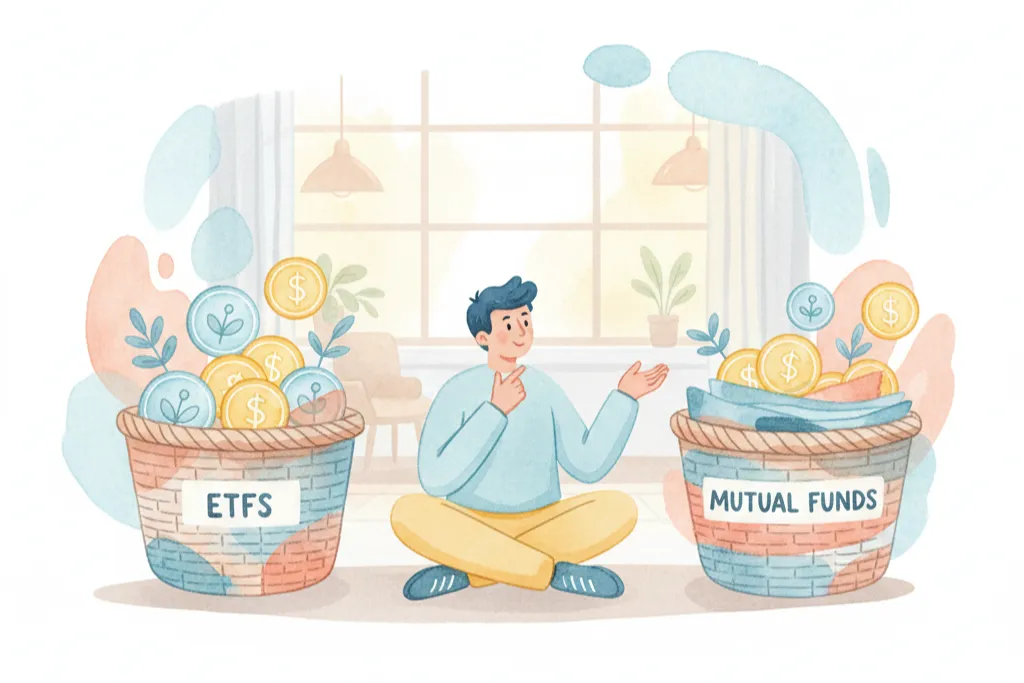
ETFs and mutual funds are both baskets of investments—but they work differently. Understanding these differences helps you choose the right tool for your investing goals.
The good news: for most investors, this choice matters less than simply starting to invest. Both can build wealth effectively.
The Core Concept
Both ETFs and mutual funds pool money from many investors to buy a collection of stocks, bonds, or other assets.
Instead of buying individual stocks yourself, you buy shares of a fund that owns hundreds (or thousands) of investments. Instant diversification with one purchase.
ETF = Exchange-Traded Fund Mutual Fund = Pooled investment fund
The main difference isn’t what they own—it’s how you buy and sell them.
How They Differ
| Feature | Mutual Funds | ETFs |
|---|---|---|
| Trading | Once per day after markets close (4 PM ET) | Throughout the day like stocks |
| Pricing | Everyone gets same price (NAV) | Prices change constantly |
| Order timing | Order at 2 PM → get 4 PM price | Buy at 10 AM → get 10 AM price |
| Order types | Market orders only | Limit orders, stop-losses available |
| Minimum investment | Often $1,000-$3,000 | No minimum beyond share price |
| Dollar amounts | Invest exact amounts ($100, $43.76) | Traditionally whole shares only |
| Fractional shares | Built-in | Now available at many brokerages |
| Automatic investing | Easy (set dollar amount monthly) | Requires fractional share support |
| Best for | ”Set and forget” strategies | Intraday flexibility |
Cost Comparison
Expense Ratios
The annual fee for fund management, expressed as a percentage.
Example: 0.10% expense ratio = $10/year per $10,000 invested
ETFs: Often slightly lower (0.03% - 0.20% for index funds) Mutual Funds: Comparable for index funds, higher for active funds
The difference is often minimal—0.03% vs 0.05% is $2/year on $10,000. But over decades, those small differences compound:
How Expense Ratios Impact Your Returns
$10,000 invested over 30 years at 7% return
Key insight: A 1% expense ratio costs you $18,500+ over 30 years. That's not a fee—it's a fortune. Always check expense ratios before investing.
Trading Costs
Mutual Funds:
- Most brokerages: Free to trade their own funds
- Some charge transaction fees for outside funds
- No bid-ask spread
ETFs:
- Most brokerages: Commission-free trading
- Small bid-ask spread (cost built into price)
- Spread is negligible for large, popular ETFs
Tax Efficiency
ETFs: More tax-efficient in taxable accounts
- Structure allows “in-kind” redemptions
- Fewer capital gains distributions
- You control when to realize gains (when you sell)
Mutual Funds: Less tax-efficient in taxable accounts
- May distribute capital gains even if you didn’t sell
- Triggered when fund manager sells holdings
- Can create tax bills without your action
In tax-advantaged accounts (401k, IRA): Difference doesn’t matter—no annual capital gains taxes.
Which to Choose?
| Choose | If You… |
|---|---|
| Mutual Funds | Have a 401(k) that only offers mutual funds |
| Want to invest exact dollar amounts automatically | |
| Prefer simplicity of once-daily pricing | |
| Are investing in tax-advantaged accounts | |
| Want Admiral Shares (Vanguard’s lowest-cost tier) | |
| ETFs | Want intraday trading flexibility |
| Are investing in a taxable account (tax efficiency) | |
| Want access to niche or specialty funds | |
| Have a broker with free ETF trading | |
| Prefer slightly lower expense ratios | |
| Either | Are buying and holding long-term |
| Are investing in tax-advantaged accounts | |
| Find the underlying investments are identical | |
| Find cost differences are minimal |
Common Fund Types
Both ETFs and mutual funds come in these varieties:
| Fund Type | What It Does | Typical Cost | Availability |
|---|---|---|---|
| Index Funds | Track a market index (S&P 500, total market) | Lowest (0.03%-0.20%) | Both ETFs and mutual funds |
| Actively Managed | Managers try to beat the market | Higher (0.5%-1.5%) | More common as mutual funds |
| Target-Date | Auto-adjust stock/bond mix as you age | Low-moderate | Primarily mutual funds |
| Sector/Specialty | Focus on specific industries (tech, healthcare) | Varies | ETFs offer more variety |
Popular Fund Examples
Broad Market Index Funds
| Fund | Type | Expense Ratio | Minimum |
|---|---|---|---|
| VTI (Vanguard Total Stock ETF) | ETF | 0.03% | 1 share (~$250) |
| VTSAX (Vanguard Total Stock Admiral) | Mutual Fund | 0.04% | $3,000 |
| FZROX (Fidelity Zero Total Market) | Mutual Fund | 0.00% | $0 |
| ITOT (iShares Total Stock ETF) | ETF | 0.03% | 1 share (~$100) |
S&P 500 Index Funds
| Fund | Type | Expense Ratio | Minimum |
|---|---|---|---|
| VOO (Vanguard S&P 500 ETF) | ETF | 0.03% | 1 share (~$500) |
| VFIAX (Vanguard 500 Admiral) | Mutual Fund | 0.04% | $3,000 |
| FXAIX (Fidelity 500 Index) | Mutual Fund | 0.015% | $0 |
| SPY (SPDR S&P 500 ETF) | ETF | 0.09% | 1 share (~$500) |
Bond Index Funds
| Fund | Type | Expense Ratio | Minimum |
|---|---|---|---|
| BND (Vanguard Total Bond ETF) | ETF | 0.03% | 1 share (~$75) |
| VBTLX (Vanguard Total Bond Admiral) | Mutual Fund | 0.05% | $3,000 |
| AGG (iShares Core Bond ETF) | ETF | 0.03% | 1 share (~$100) |
The Active vs. Passive Question
More important than ETF vs. mutual fund: active vs. passive investing.
| Factor | Passive (Index) Funds | Active Funds |
|---|---|---|
| Strategy | Track an index | Manager tries to beat market |
| Cost | 0.03% - 0.20% | 0.5% - 1.5% |
| Performance | Matches market | Some outperform, most underperform |
| 15-year track record | Beat ~80% of active funds | ~80% trail their benchmark after fees |
The evidence is clear: For most investors, low-cost index funds (whether ETF or mutual fund) outperform active management over time.
Building Your Portfolio
Simple Three-Fund Portfolio
A classic approach using either ETFs or mutual funds:
- U.S. Total Stock Market (60-70%)
- International Stock Market (20-30%)
- U.S. Bond Market (10-20%)
As ETFs:
- VTI + VXUS + BND
As Mutual Funds:
- VTSAX + VTIAX + VBTLX
Same investments, same diversification—different wrappers.
Target-Date Alternative
Even simpler: one target-date fund holds everything.
Vanguard Target Retirement 2050 (VFIFX):
- Automatically owns U.S. stocks, international stocks, bonds
- Rebalances automatically
- Becomes more conservative as 2050 approaches
Set contribution to one fund and never think about allocation again.
Common Mistakes
Obsessing Over ETF vs. Mutual Fund
The difference is minor. What matters:
- Are you investing consistently?
- Are costs low?
- Are you diversified?
Spending weeks deciding between VTI and VTSAX is wasted energy—they’re essentially identical.
Paying High Fees
Expense ratios above 0.5% are hard to justify for broad market exposure. Index funds should cost 0.20% or less.
Trading ETFs Actively
ETFs enable day trading, but that doesn’t mean you should. Buy and hold. Ignore daily prices. Trading actively destroys returns for most people.
Ignoring Tax Location
If you have both taxable and tax-advantaged accounts:
- Put tax-efficient investments (ETFs, growth stocks) in taxable
- Put tax-inefficient investments (bonds, REITs) in tax-advantaged
Practical Recommendations
If You Have a 401(k)
Use whatever low-cost index funds are available. Most 401(k)s only offer mutual funds—that’s fine. Look for:
- S&P 500 or total market index fund
- Target-date fund matching your retirement year
If You Have an IRA
ETFs or mutual funds both work. Consider:
- Fidelity or Schwab mutual funds (often $0 minimum)
- Vanguard ETFs (no minimum beyond share price)
If You Have a Taxable Account
ETFs offer tax advantages here:
- Lower capital gains distributions
- You control when to realize gains
If You’re Just Starting
Go simple:
- One target-date fund, or
- One total market index fund
- Either ETF or mutual fund—just start
Your Action Plan
This week:
- Check what funds are available in your 401(k)
- Look up expense ratios on your current investments
- Learn what index your funds track
This month:
- Consolidate to low-cost index funds if needed
- Set up automatic contributions
- Choose an appropriate stock/bond allocation
Ongoing:
- Ignore the ETF vs. mutual fund debate
- Focus on consistent investing
- Rebalance annually
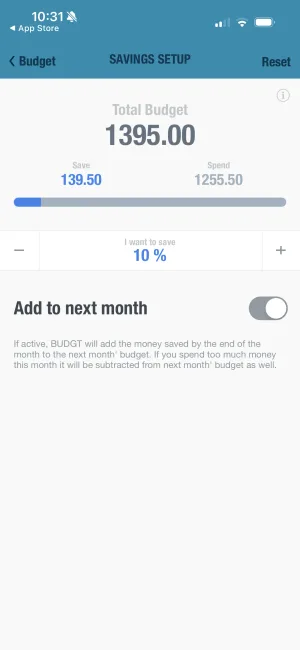
Building wealth requires consistent investing. BUDGT helps you know exactly what you can spend each day—leaving room for regular fund contributions.
Frequently Asked Questions
What is the main difference between ETFs and mutual funds?
The main difference is how they trade. ETFs trade throughout the day like stocks at constantly changing prices. Mutual funds trade once daily after markets close, with everyone getting the same price. Both can hold the same investments—the difference is the wrapper, not the contents.
Which has lower fees, ETFs or mutual funds?
ETFs typically have slightly lower expense ratios because they're cheaper to administer. However, the difference is often minimal (0.03% vs 0.04% for many index funds). Some mutual funds match ETF costs. Compare specific funds rather than assuming one type is always cheaper.
Are ETFs better for beginners?
Both work well for beginners. Mutual funds may be simpler because you can invest exact dollar amounts and set up automatic investments easily. ETFs require buying whole shares (unless using fractional shares) and may feel more complex due to real-time pricing.
Can I hold both ETFs and mutual funds?
Absolutely. Many investors use mutual funds in 401(k)s (where ETFs may not be available) and ETFs in IRAs or taxable accounts. The important thing is what the funds invest in, not the fund structure itself. A total market ETF and total market mutual fund serve the same purpose.
Which is more tax-efficient?
ETFs are generally more tax-efficient in taxable accounts due to their structure (in-kind redemptions avoid triggering capital gains). In tax-advantaged accounts like 401(k)s and IRAs, this difference doesn't matter since gains aren't taxed annually anyway.
What is an expense ratio?
The expense ratio is the annual fee charged by the fund, expressed as a percentage of your investment. A 0.10% expense ratio means you pay $1 per year for every $1,000 invested. These fees are deducted automatically from the fund's returns—you never see a separate bill.
Should I choose active or passive funds?
For most investors, passive (index) funds are better. They're cheaper, more tax-efficient, and historically outperform most active funds over time. Passive funds simply track an index; active funds try to beat the market but usually fail after fees.
Related Articles



Ready to take control of your budget?
Download BUDGT and start tracking your daily spending today.