How to Budget on a $60,000 Salary: Daily Spending + Savings Guide

A $60,000 salary sits right around the US median for full-time workers — which makes it one of the most important income levels to budget well. You earn enough to save consistently and build real security, but not so much that you can absorb careless spending. The habits you build here decide whether $60K feels tight or comfortable.
Let’s break down exactly how to budget on $60,000 a year, from your monthly split to the one number that actually matters day to day: what you can safely spend today.
Your $60K Monthly Breakdown
Here’s what $60,000 looks like once you break it down. A $60,000 annual salary works out to $5,000 a month gross. After federal tax, FICA, and state tax — roughly $850 a month on average — you’re left with an estimated take-home of about $4,150 a month.
That take-home figure is the one that matters, and it varies by state: no-income-tax states like Texas or Florida land higher, while California or New York land lower. Pre-tax 401(k) contributions also lower your taxable income, so if you contribute through your employer, your paycheck tax bite will be a little smaller than the estimate above. We’ll budget from the ~$4,150 take-home number throughout, since that’s the money that actually hits your account and that you get to allocate.
Recommended Budget Allocation
Here’s a realistic monthly allocation for $60K, built around a 25% housing cap and a 15% savings rate. Percentages are shown as a share of your $5,000 gross:
$60K Monthly Budget Split (Take-Home)
Full Monthly Budget Table
| Category | Amount | % of Gross | Notes |
|---|---|---|---|
| Housing | $1,250 | 25% | Rent or mortgage |
| Food & Groceries | $600 | 12% | Cooking at home most nights |
| Personal, Dining & Fun | $700 | 14% | Eating out, hobbies, subscriptions |
| Savings & Investing | $750 | 15% | 401(k), IRA, emergency fund |
| Transportation | $450 | 9% | Car payment, gas, insurance |
| Utilities | $200 | 4% | Electric, gas, internet, phone |
| Healthcare | $200 | 4% | Premiums, copays, prescriptions |
| Total (take-home) | $4,150 | 83% | The other ~17% is taxes |
Your Daily Budget: About $43
The categories above are useful for planning, but you don’t live your life in monthly buckets — you make spending decisions today. So the number that actually keeps you on track is your daily flexible budget: what’s left for groceries, dining, and fun after your fixed commitments and savings are set aside.
| Step | Calculation | Running Total |
|---|---|---|
| Monthly take-home | — | $4,150 |
| Minus housing | $4,150 − $1,250 | $2,900 |
| Minus utilities | $2,900 − $200 | $2,700 |
| Minus transportation | $2,700 − $450 | $2,250 |
| Minus healthcare | $2,250 − $200 | $2,050 |
| Minus savings (15%) | $2,050 − $750 | $1,300 |
| Flexible monthly (food + fun) | — | $1,300 |
| Daily budget | $1,300 ÷ 30 days | ~$43 |
That $43 covers groceries, coffee, takeout, and everyday extras. It sounds modest, but it’s honest — and knowing it means you never hit the end of the month wondering where your paycheck went.
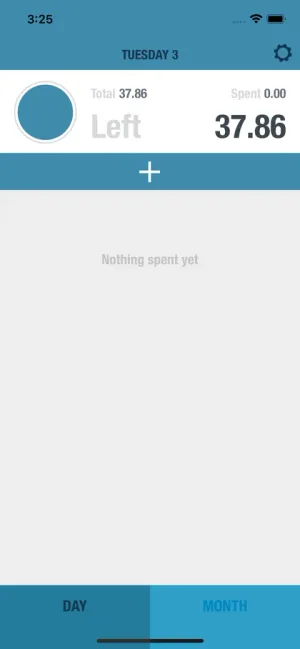
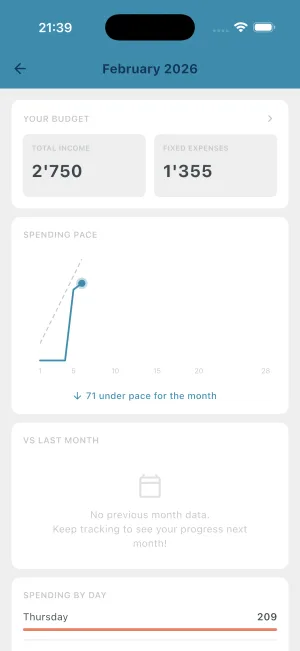
This is exactly the calculation BUDGT does automatically. You set your income, your fixed expenses, and your savings goal once; the app reserves all of that and shows you a single daily number that updates as you spend.
The 50/30/20 View of $60K
Another way to sanity-check your budget is the classic 50/30/20 rule: 50% to needs, 30% to wants, 20% to savings. Here’s the target split on a $60K take-home:
50/30/20 Target on $60K Take-Home
In the real world, most $60K earners land closer to 15% savings than 20% — especially early on, or in a pricey city. That’s fine. Use 50/30/20 as a target, not a verdict. The point is to move your savings rate up over time, not to feel bad about where you start.
The $60K Savings Strategy
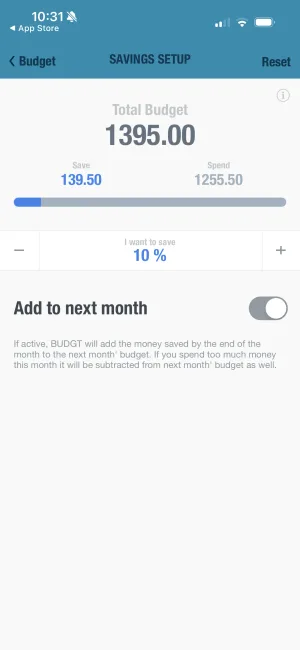
Fifteen percent of $60K is $750/month, or $9,000/year. Here’s the order that gets the most out of every dollar:
| Priority | Where it goes | Monthly | Why |
|---|---|---|---|
| 1 | 401(k) up to employer match | ~$250* | It’s free money — never leave it on the table |
| 2 | Starter emergency fund | ~$250 | Get to $1,000 fast, then build toward 3-6 months |
| 3 | Roth IRA | ~$250 | Tax-free growth; you easily qualify at this income |
*Assumes a common 5% match on a $60K salary.
What $60K Can Realistically Do
- Capture your full 401(k) match ✓
- Build a starter emergency fund in a few months ✓
- Contribute meaningfully to a Roth IRA every year ✓
- Reach a 3-month emergency fund ($7,500-$9,000) inside two years ✓
You may not max every account right away — and that’s okay. Consistency at 15% beats a heroic 25% that you abandon after two months.
Housing: Why 25% Is the Line That Matters
Housing is the single biggest lever in your budget. On $60K, the 25% target is $1,250/month, and every dollar past it comes straight out of your daily life. Hold rent at 25% ($1,250) and you keep roughly $43/day of flexible spending. Stretch to 28% ($1,400) and it drops to about $38/day; go to 30% ($1,500) and you’re down near $35/day.
That gap between $43 and $35 a day is about $240 a month — roughly a full Roth IRA contribution disappearing into rent. In a high cost-of-living city you may genuinely have to stretch toward 30%, and that’s a valid choice; just make it knowing exactly what it costs you rather than by accident.
What $1,250 Rents in 2026
What that budget actually gets you depends heavily on where you live. In lower-cost areas — much of the Midwest and South — $1,250 can rent a one- or two-bedroom apartment, and sometimes a small house. In medium-cost cities like Denver, Austin, or Raleigh, it’s more likely a one-bedroom in a decent area. And in the priciest markets — New York, San Francisco, Los Angeles — $1,250 usually means a room in a shared place or a longer commute from a more affordable neighborhood. If your market makes 25% impossible, that’s a signal to weigh roommates, location, or a longer-term plan to raise income, rather than quietly letting housing swallow your savings rate.
Common $60K Budgeting Mistakes
1. Treating gross like take-home
$60K sounds like $5,000/month, but you spend the ~$4,150 that lands in your account. Budget the real number.
2. Waiting to save “until things settle down”
Things rarely settle down. A small automatic transfer today beats a big intention later — compounding rewards the early start, not the perfect one.
3. Letting fixed costs creep
Rent, car payments, and subscriptions are sticky. Every dollar you lock into a fixed bill is a dollar you can’t flex when life happens.
4. Budgeting in your head
The end-of-month shortfall almost always comes from small daily spending you never tracked. One glance at a daily number fixes this.
Your First 60 Days on $60K
Where Your First $750/Month of Savings Goes
Weeks 1-2 — Set the foundation
- Calculate your real take-home and set your daily budget (~$43)
- Enroll in your 401(k) up to the full employer match
- Open a high-yield savings account for your emergency fund
Weeks 3-4 — Automate
- Auto-transfer savings on payday, before you can spend it
- Cancel subscriptions you forgot you had (check the last 3 months)
- Start logging daily spending to see your real patterns
Weeks 5-8 — Optimize
- Review your first month: which category ran over?
- Nudge your savings rate up by 1-2% if the daily number allows
- Lock in the habit — this is the part that compounds
Adjusting $60K for Your Situation
The numbers above are a solid starting template, but your real budget depends on a few personal factors worth naming. Where you live is the biggest: in a high cost-of-living city, housing alone can force trade-offs elsewhere, and it’s better to consciously lower your savings rate for a while than to pretend the rent fits when it doesn’t. Whether you have debt matters too — if you’re carrying high-interest balances, it’s usually worth routing part of that 15% savings toward the debt first, since paying off a 20% credit card is a guaranteed 20% return. And whether you have dependents reshapes the food and personal categories significantly.
The point of a framework like this isn’t to follow it to the dollar — it’s to give you a sensible default you can adjust from. Start here, run your actual numbers through the calculator, and shift the percentages to fit your life. A budget that’s roughly right and that you actually follow beats a “perfect” one that ignores your reality.
The Bottom Line
A $60,000 salary is a genuinely workable income almost everywhere in the US. On $60K you can:
- Cover a reasonable rent at 25% of income
- Save a steady 15% while still living your life
- Build an emergency fund within two years
- Spend around $43/day, guilt-free, because the rest is already handled
The trick at this income isn’t earning more — it’s making sure you always know what’s safe to spend today. Get that number right, protect your savings rate, and $60K stops feeling like “just getting by” and starts building real momentum.
Earning $60K and want it to go further? BUDGT shows your daily spending limit after bills and savings — so you build security without giving up the everyday things you enjoy.
Frequently Asked Questions
How much should I save on a $60,000 salary?
At $60K, aim to save 15-20% of your income — that's roughly $750-$1,000/month. Start with enough 401(k) to capture your full employer match (free money), then build a starter emergency fund, then work toward maxing a Roth IRA.
How much rent can I afford on $60,000 a year?
Following the 25-30% rule, you can afford $1,250-$1,500/month in rent on a $60K salary. Staying near 25% ($1,250) leaves more room for saving and everyday spending. Every $150 you add to rent takes about $5/day off your flexible budget.
What is the take-home pay on a $60,000 salary?
After federal tax, FICA, and state tax (varies by state), take-home pay on $60K is roughly $4,000-$4,300/month. Pre-tax 401(k) contributions lower your taxable income and can increase the value of every dollar you save.
How much can I spend per day on a $60K salary?
After housing ($1,250), fixed bills, and saving 15%, your flexible daily budget for groceries, dining, and fun is approximately $43. That's the number BUDGT surfaces so you always know what's safe to spend today.
Is $60,000 a good salary in 2026?
$60,000 is around the US median for a full-time worker and provides comfortable living in most of the country. It's enough to save consistently and build an emergency fund, though high cost-of-living cities require tighter housing choices.
Related Articles



Ready to take control of your budget?
Download BUDGT and start tracking your daily spending today.